

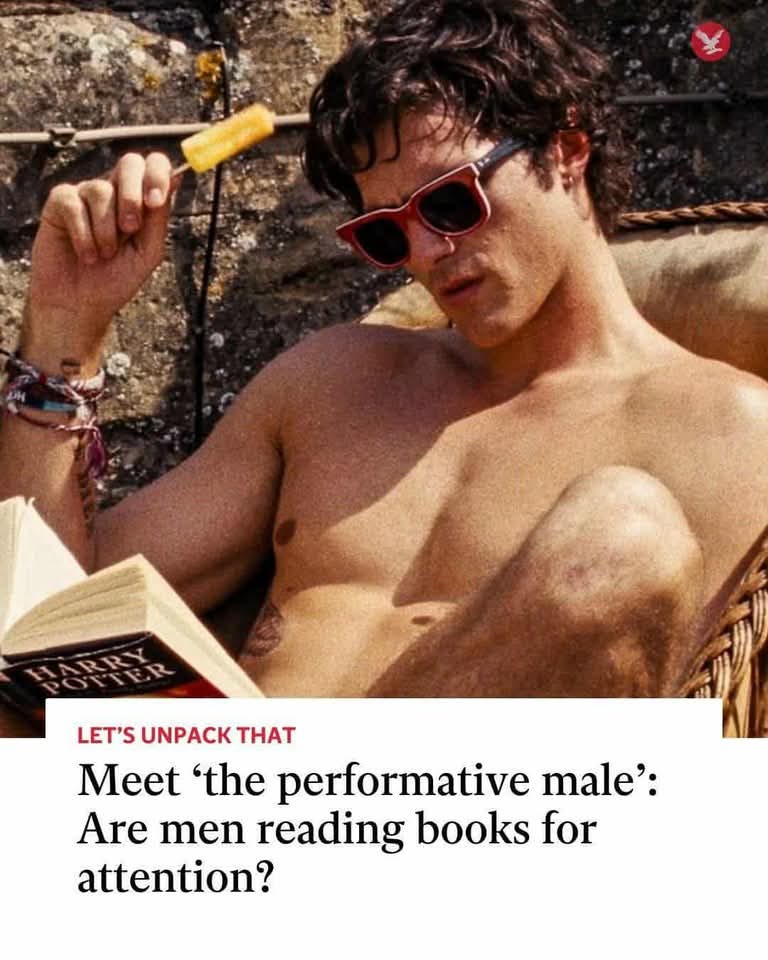
It is true that being a poseur isn’t nearly as much of a social sin as it was when I was growing up, and this trend of increasing shamelessness has been a blight on our public spaces. A healthy dose of mockery and derision is an effective check on petty fraudulence, and it’s unfortunate that the Let People Enjoy Things sentiment has been perceived to be this catch-all immunization from criticism, or even a baseline standard of decency. It is also true that one of the most annoying aspects of social media is that it has flattened all sense of morality until something like forgetting to refill the Britta is equated with beating your girlfriend with a broomstick. Shaming can be necessary, but it’s a matter of perspective.
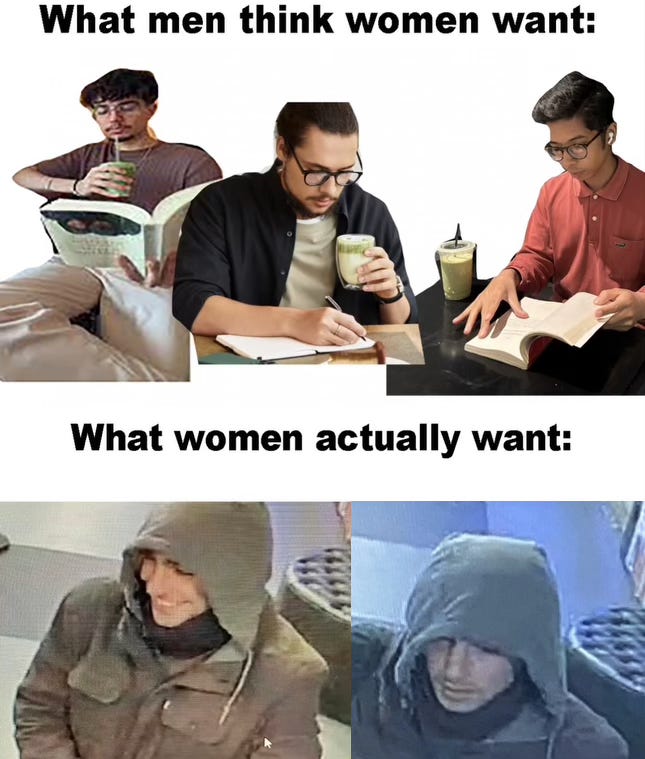
I’ve been seeing a lot of “performative male” memes the past few months, and given the state of the world or even the soy right, this seems like such a weird niche to mock. Sure, maybe there are guys who chill in a café and wear a vintage-style graphic tee-shirt of Black Panther, rounded glasses, a rolled up beanie, and slutty shorts that reveal a thigh tattoo that’s a line drawing of a snake wrapping around a sword—and, of course, they’re Weird Almaxxing with the cliché mullet/skinny moustache combo. Maybe they’re hoping a woman will catch them perusing a Judith Butler book and stop to admire their complexity and internal beauty, and think, He’s not like other guys… He must be deep… And maybe they plastered “ethical non-monogamy” all over their Hinge profile along with “My kink is… deep meaningful conversations.” And maybe these men claim to believe that women are strong and capable, but will still sometimes fact-check them, hold them accountable, etc. And maybe they’ll engage in some flirty small talk and the song “Congratulations” by MGMT begins to play in the background and they’ll say something like, “You know, this song sounds like Mac DeMarco, but it’s actually the Strokes. I get why a casual listener would confuse the two because they both share a kind of surfy chill vibe.” Sure, maybe this caricature exists. Or it’s more likely that this is an update on the tired, played-out discourse about What Liking David Foster Wallace Says About You, or what Sam Kriss has described as “the person-guy.”
In the case of a specific segment of men who are only acting this way for clout or to get in someone’s pants, it is admittedly try-hard and disingenuous behavior. But I don’t see how this is any more cynical or deserving of mockery than, say, the Democratic Party’s performative allyship to conceal their corporatist agenda—like ditching #MeToo to re-embrace a disgraced sex pest running a campaign on increasingly blatant Islamophobia in hopes of warding off a mayoral candidate who wants to give New Yorkers free bus rides. Again, effective shaming is a matter of perspective.
To the extent that our current ultra-dire national moment is the result of an extended masculine freakout, the deepest irony here is that the “performative male” trend could also be a genuine, albeit misguided, attempt to escape the rigid, toxic performance of “traditional” masculinity. The basis of identity for a mid-20th-century man was deeply entwined with what he made—he was a steelworker, a carpenter, a mechanic—and their value to themselves and their community was tied to a tangible contribution. For today’s males, our labor is more abstract, precarious, and often digitally mediated: The gig economy, the service industry, the bullshit office job. Men are building fewer cars and houses, and instead, are making spreadsheets and managing a brand’s social media account. If men are identifying less with work, a vacuum is created, and we define ourselves not by what we do but by what we consume.
The “performative male” is an assemblage of trends, fashions, accessories, and affectations. The tote bag and Sally Rooney novel and oat milk matcha and Carhartt beanie are Lego bricks in the construction of the self as a brand, a specific kit of signifiers. And this turns social interactions into transactions, or a marketing strategy. He’s not just reading feminist literature; he’s signalling his empathy for social justice to a target demographic. This is an inevitability when the logic of the market has so thoroughly saturated our lives, so we apply ROI calculations to our dating prospects and personal ethics. This aesthetic is also a contrast from the sigma grinset Andrew Tate manosphere meatheads, but this deviation only reinforces the totalizing logic of the market. It’s an attempt to find authenticity that is built from mass-produced, inauthentic parts. The problem isn’t that these men are “cringe,” or that they’re posing as soy softbois to attract women. The tragedy is that their very real human desire for identity, connection, and meaning is channeled into consumerist bullshit and online trends. The ultimate “performance” is the one that late-stage capitalism demands of all of us: To constantly build and market a personal brand.
Everything can be perceived as “performative” on social media—especially with all the tools, functions, and business objectives built around getting attention, likes, and followers. Even the jokes mocking “performative males” are inherently performative. Being human is a performance. We socially construct gender, decide how it’s expressed, and conduct ourselves in a certain way to attract who we want. Something as seemingly innocuous as matcha has no natural significance in gender or self-expression, but it has been socially assigned through cultural norms and advertising, so it’s used as a tool to attract who we want. If we like someone, we will naturally want to get closer to them, so we inevitably mirror their body language and speech, and even adopt their habits and hobbies. Or, maybe some dudes just want to sip on some matcha; god forbid a guy try to catch a vibe.

 Tiktok failed to load.
Enable 3rd party cookies or use another browser
But the way the internet has soiled literally everything in our lives is depressing. One aspect of the “performative male” meme that’s particularly irksome is the extension of this idea that reading in public is inherently performative. At a time when attention spans are decimated and ChatGPT is making us dumber and the average American reads at a middle school level (if they even make it past a headline), it’s disappointing to see this widespread shaming of public reading. Just to further reiterate, again, maybe we should reevaluate who or what is deserving of this level of shaming:
Even if public reading were a form of virtue signalling, is it any worse than the absolutely unhinged behavior you’d see on Influencers in the Wild?
Is “performative reading” as much of an epidemic as the countless people who are so glued to their phones that they lose all sense of situational awareness and will block an entire escalator or refuse to move out of the way when they’re standing in front of a subway door?
Is doomscrolling in public also a form of performative reading?
People do not read to be in public—they happen to be in public and they read while they’re there. It’s nice to get out of the apartment and have some background noise. On the subway commute to/from work, a hardcover book is a pleasant break from leering into a screen all day. Many readers genuinely enjoy flipping through physical books in various spaces, and it has nothing to do with performing for others. Maybe they got bored with being in their apartment. Maybe they’re waiting for someone. Maybe they wanted a coffee while lounging in a well-decorated space. Maybe they’re enjoying a sunny day at the beach, and the gentle crashing of waves provides a soothing ambience. Maybe people want to use their imagination for something other than speedrunning through the worst-case scenarios that could happen to them. If you don’t understand the appeal of reading in public, that’s fine, but it is very revealing if you assume it’s mostly performative.
UGHHH… Why are people so performative in public?? I saw somebody with an umbrella today, like, we get it… you want your fit to stay dry. Does everybody need to know that you don’t like to get wet??
The online derision against “performative males” or “performative reading” is what happens when every nuance or quirk or interest is viewed as a meme.1 When it’s cringe to express yourself, that attitude inadvertently defaults to: There should be nothing to distinguish anyone from anyone else. The people mocking this trend are morphing themselves into whatever the algorithm upvotes. Even if some of these men are adopting this aesthetic to masquerade as left-leaning fembois to disingenuously appeal to women, this functions more as an assumption or stereotype. I’m not sure how useful it is to glean the intentions, character, or motivations of an individual based on how they dress or what they read. And the first step towards authenticity is to stop giving a shit about the opinions of idiots on the internet.
Just to spite these haters and losers, the next time I decide to read in public, I’ll pull up to a café wearing a “performative male” outfit—which is essentially whatever lesbians were wearing five years ago. My tote bag will contain a Clairo record, a thrifted babushka, organic almond milk, and an Erewhon limited-edition Labubu. Onlookers will think I’m going to pull out something sophisticated like Intermezzo, but instead, I’m whipping out a copy of The Very Hungry Caterpillar. I’ll contort my facial expressions to look like I’m struggling to parse through a dense, hyper-philosophical tome that only the most profound of intellectuals could ever hope to comprehend. I’ll furrow my brow, look frustrated while whispering “what the fuck does that even mean” under my breath, and periodically pause to pull a red crayon that was tucked behind my ear and scribble annotations in those wide margins.
Although if we are going to categorize male readers, let’s do this properly.
There are plenty of other groups (War Guys, History Buffs, Sports Nuts, Critical Theory Nerds), but male readers in their 20s and 30s broadly fit into one of the following:
Joe Rogan Extended Universe: Scott Galloway, Jordan Peterson, Yuval Noah Harari, Robert Greene, David Goggins, self-help books with curse words in the title, Malcolm Gladwell, that one Rick Rubin book for some reason.
Aspiring Intellectuals: David Foster Wallace, James Joyce, Thomas Pynchon, Fyodor Dostoyevsky, Franz Kafka, Cormac McCarthy, East of Eden, Stoner, maybe Nabokov, maybe Myth of Sisyphus or Either/Or.
Reading for Female Validation: Sally Rooney, Ocean Vuong, Ursula K. Le Guin, Ottessa Moshfegh, Mona Awad, Bell Hooks, Douglas Stuart, A Little Life, The Secret History, maybe James Baldwin or Joan Didion.
Yes, I have read books and authors in all three categories.
i’ve been personally attacked no less than 15 times in this
I must say that I'm profoundly thankful for having been "performatively" reading in the late 90s and early 00s, before social media ruined it. I could read my Naked Lunch, Tropic of Cancer, and the well-worn, leather-bound copy of Don Quixote with the Gustav Doré plates without shame or ridicule. Nubile co-eds would stop to ask if Don Quixote was hard or boring, and then I would wax poetic that it was a fantastic read with relevance to the turn of the Century, and then explain that I acquired it while working for book credit at the Occult Bookstore I worked at on Saturday mornings for fun. Then we would finish our cappuccinos and make plans to meet at the new brewery Friday after class for a few beers and then snog at the park near Boulder Creek. This is all 100% true.
Today's performative males don't know what they missed being born 20 years too late.