

“Not everything that counts can be counted. Not everything that can be counted counts.”
—Albert Einstein
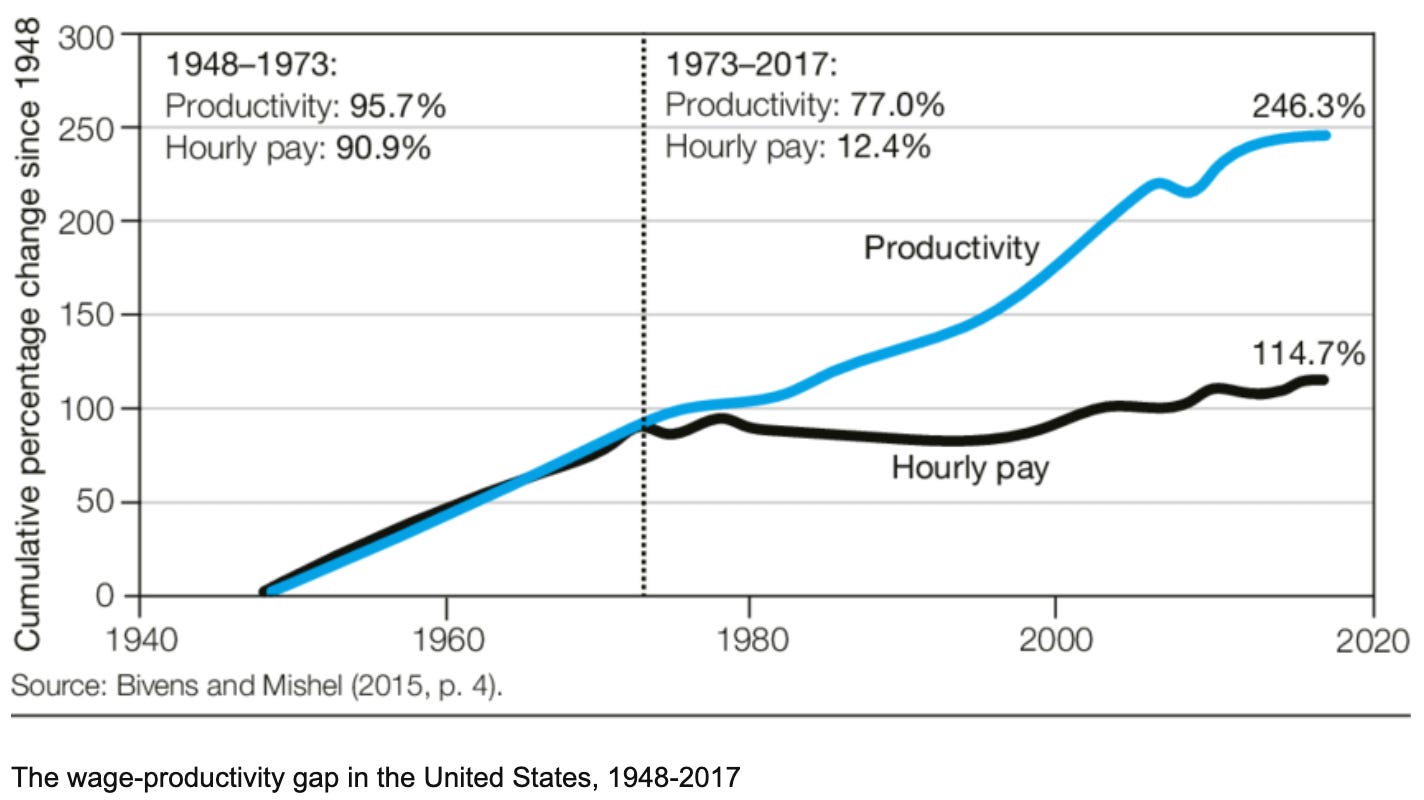
Only a slave would quantify their life through productivity. About a month ago, a clip from the Diary of a CEO podcast resurfaced in which the host recounted how having three glasses of wine ruined the next three days of his life. “It meant that I got worse sleep that night, I ate more poorly the next day because my dopamine system or the cortisol system or whatever was all messed up,” said Steven Bartlett. “Then I podcasted worse, and I didn’t go to the gym the day after, and I could track all of this on my Whoop.” I’m not one to romanticize the Mad Men era of office culture, but at least those guys could function with a mild hangover. As a 30-something millennial, I can sympathize with the brutal compounding effects of binge drinking, but this guy frames his bodily functions through the lens of operational management. This efficiency mindset disregards any relationship or experience that doesn’t carry a quantifiable monetary benefit. It posits that our lives have no significance beyond productivity, that we should feel guilty for unwinding and enjoying simple pleasures. Humans were not meant to be this efficient, and our minds and bodies were not built to withstand such omnipresent optimization. Treating life as a series of benchmarks or KPIs is leaving us burnt out and depressed.
These sigma grindset types attach a moral quality to the idea of “efficiency” when, in practice, it’s a value-neutral concept. If you are so inclined to consider efficiency as an inherent good, well, a nuclear bomb is very efficient at causing mass death. Or take the classic question of trade-offs: How do you make the most bread from the least wheat? Bakers of previous centuries sometimes mixed flour with chalk or gypsum to make “more” bread, but then people were eating powdered rock; alum could whiten loaves on the cheap, but it has destructive effects on the human digestive system, and even killed children during the Victorian era. In our modern algorithmic-driven culture, efficiency is just outsourcing creative vision to data, so the mainstream is now a factory shoot of Captain America reboots and Post Malone, but country.
In a world premised on financialization, speculative risk management, extractive logic, highly leveraged debt, and short-term profits, this raises a question we don’t ask enough: Efficient for whom? The question of efficiency seems to be oriented around quarterly profits, not how a company treats its employees, the social value of its product, or the impact on its community. It’s a bit of a tell that this question is never directed at a healthcare system that costs twice as much per capita as other developed nations, while producing middling outcomes and leaving 26 million uninsured.
The neoliberal model of work is built to reward fiercely competitive and annoyingly ambitious strivers. It’s important to understand that neoliberalism is as much a political project as an economic one, because it naturalizes an ideology that assumes ambition as a noble aspiration rather than a personality trait. History’s most grotesque monsters didn’t cause mass suffering through laziness, but through empty ambition channeled to nefarious ends. Who’s a “worse person”—the slacker who smokes weed all day or someone in the Third Reich working very hard to carry out a genocide? European countries operate on a fundamentally different premise of the purpose of work: The Dutch have a concept called “gezelligheid,” the Danish have “hygge,” which are examples of societies that have built institutional structures around the idea that contentment is a legitimate end-state.
I came across a video that described management consultants as the “looksmaxxers of the business world” because both are obsessed with optimizing for quantifiable metrics at the expense of any other consideration. When Clavicular rambles about “golden ratios” and the “optimal male face,” his brainrot nonsense is not that far removed from corporate vanity metrics and the way management consultants are trained to dismiss anything that can’t be quantitatively rationalized. In philosophical terms, this is a financial ontology that conceives of tradeable assets as the only things that truly exist, and it’s a business epistemology that only perceives what can be quantified as a valid source of truth. It explains why anxious overachievers tend to treat the human experience as a series of metrics to optimize: Strava updates, obsessive caloric deficits, Goodreads end-of-year stats, status credits, and Apple Watch notifications. It seems like consultants would rather do something wrong that they can control than do something right that they can’t, like tanking Nike’s stock value by shifting their marketing budget to short-term performance ads, even when it corrodes a blue-chip brand.
As financialization has become an epistemic and ontological source of truth and meaning, it’s at direct odds with societal logic that prioritizes any other intrinsic human value. Consultant-brain taps into what Rory Sutherland has dubbed “the doorman fallacy,” which is when a business strategy becomes synonymous with cost-saving and efficiency by reducing a human role to its most obvious, visible tasks. In this instance, if a doorman is only perceived as someone who opens a door, they can be replaced with a cheaper and faster automatic sliding door; but a doorman also provides a baseline level of security, monitors who comes and goes, brings order to the common area, recognizes and greets regulars, helps with bags, and hails taxis. They were the first impression of an establishment and made it feel more premium. All of these intangibles are overlooked because they can’t be easily measured—and once value is defined by what can only be measured, businesses are optimized around that definition. Anything that seems inefficient gets cut, which is why employees are now seen as a line item expense to be reduced, rather than a collective of expertise and cultural cohesion to be invested in. This also gets to the principle of Chesterton’s Fence, which states: “Don’t ever take a fence down until you know the reason it was put up.” The doorman didn’t just open doors, and building a business strategy around this idea means that an enterprise isn’t just cutting costs; they’re removing the reason why people chose them at all.
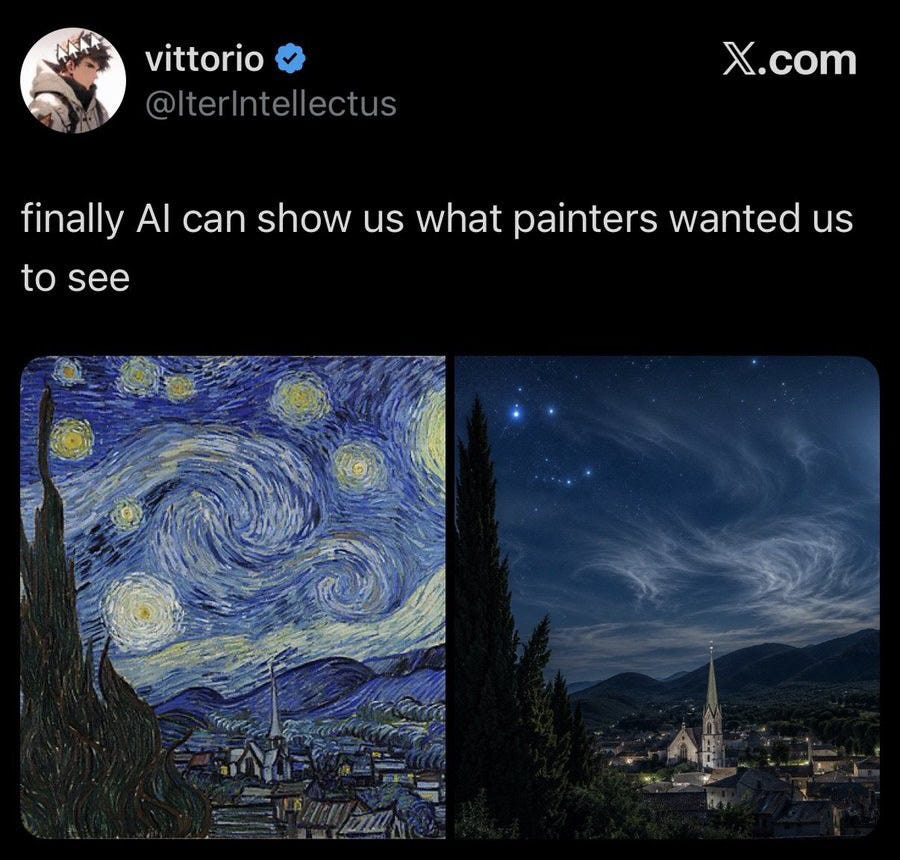
If management consultants are efficiency personified, then AI is efficiency as a technological manifestation. So much of the discourse around slop focuses on the dross that AI spits out, like bunnies on trampolines or ChatGPT “It’s not just X, it’s Y”-style writing or vaguely unsettling AI commercials. This is the aesthetics of slop, but slop is the bedrock of the modern economy. Gentrified neighborhoods and suburban hamlets are lined with the same VC-backed sans-serif slop bowl chains. The same retail stores merch the same products and reproduce the same vibe indefinitely. The color is literally draining from our world, from our cars to cookie-cutter beige luxury apartments. Entertainment is saturated in Soylent Green or Netflix center-frame neon lighting, or its content is reconstituted IP presented as an epic new spin-off. Galleries are turning into blank-street-ified failed luxury brands, cities feel like a corporate Disneyland, and our favorite bagel place has turned into a venture-backed corporation. Creativity predominantly exists to facilitate product placements, branding opportunities, and cross-promotions. Slop is the aesthetics of consolidation, as less competition exerts a gravitational pull toward the average. Ironically, neoliberalism is producing the same homogeneity we were told was only possible under communism.
The proliferation of AI slop needs to be situated within the context of a society that has been force-fed lowest-common-denominator dreck for at least a decade. Mark Fisher wrote about how the narrative of technology has shifted from offering the hope of new futures and possibilities to now subordinating us to the repetition and refurbishment of established cultural norms. Maybe what repulses us about AI slop is how it reflects our mediocre imaginations of how to marshal god-like technology and godly amounts of capital. As Andrew deWaard explains in his book, Derivative Media: How Wall Street Devours Culture, cultural products have become derivative of both prior media and of the business decisions of the companies that fund them. So the speculative value of a cultural object is prioritized over the human value of that object—whether it’s a movie aimed at hocking merchandise or a song aiming to go viral on TikTok or a song that’s treated like an asset to be reused as a sample of interpolation. There’s been a bidding war over who will take over Paramount and Warner Bros., and Netflix, because films and IP have become financial assets to be held in a portfolio. In this context, slop is the product of a society unable to articulate a reason for something to exist beyond ROI.
Pop culture reflects the financial conditions under which it is produced, so if we passively consume algorithmically fed content, we’re unconsciously internalizing the very logic that reflects the unquestioning parade of optimization and efficiency. This culture is shaping our taste, values, and imagination. Spotify used to employ curators to build playlists based on what was new and exciting in music, and now they’re pumping out AI-generated playlists aimed at maximizing user engagement. When a certain type of song is amplified by AI, artists are incentivized to replicate it in hopes of getting their music on a playlist that’s shaped by machine learning. In the realm of television and film, we’re trapped in an era where entertainment has been reduced to a product to capture attention or push us through a sales funnel. In an interview to promote his Netflix show Maniac, Cary Joji Fukunaga essentially admitted that the streaming giant had an in-house algorithm that not only determined which shows would be green-lit, but also determined the content of green-lit shows. Narrative elements and story beats are market-tested and, therefore, non-negotiable. There’s still plenty of quality music and shows and movies being made, but it’s done in spite of business pressures, and this level of bet-hedging and risk-aversion makes a farce of neoliberalism as an engine of innovation and creativity.
In a podcast with David Senra, Strauss Zelnick—the CEO of Take-Two Interactive, which is responsible for Grand Theft Auto—discussed the myths around AI and how an over-reliance on data is corrosive to creativity:
“AI is big data sets, lots of compute, and a large language model mushed together. So data sets, by their very nature, are backward looking. Creativity, by its very nature, is forward looking.”
Similarly, W. David Marx writes in Blank Space: A Cultural History of the Twenty-First Century:
“Relying too heavily on data to shape creative decisions misunderstands the nature of culture. The role of true creative inventors is not to follow taste, but to invent what will excite and challenge people next.
It’s ironic that a big-budget Star Wars film was bodied at the box office by two YouTube films that sound like strip clubs about to be shut down by a city government. It doesn’t help that the Baby Yoda film has a title that reads like it was focus-grouped for SEO, and it requires some back reading since it’s a spin-off of a TV show that was a spin-off of a reboot of a classic film franchise. It’s refreshing to see new stories get funded, and we need to see more of this in TV since every show is either about old cowboys in Wyoming or rich people having affairs.
We’ve been sold the delusion that corporate interests align with human interests, and their cult of efficiency is a psychotically shortsighted race-to-the-bottom, the perfectly demented intersection of private equity mindset and engineer’s disease. It’s a byproduct of a growth-at-any-cost economy that transforms citizens into consumers, then subjects consumers to enshittification of all kinds. Instead of being civically engaged agents of change, we become price counters, voting with our wallets and expressing ourselves through social media posts, which are then harvested as data points. From optimizing day cares to veterinary clinics, vast tracts of the economy marshal energy and resources to create virtual wealth that loops back on itself with debt to create fake expansion with no communal benefits. We’ve seen the economic, cultural, and spiritual costs of this hyper-growth fantasy and the tyranny of measurability. Now the physical costs are making headlines: 50°C in India, water tables lowered and land subsidence in California, oil shocks, shortages of fertilizers and cooking fuel, desertification, biosphere destruction, uncontrollable war, the fragmentation of the financial system, and so on. We need to demand a world that’s driven by human needs, because efficiency under this context is synonymous with cost-cutting. And when the last vestiges of humanity become too inefficient for capitalists to maintain, we’ll be the next line item to be cut for more profit.

Great summary on the culture war at hand! It's hard not to talk about the absence of inspiring culture these days. It feels like as creators we have the power to fill the sucking void of good music, movies, books and magazines...but we have always been doing that, plus fighting against the corporate machine to reach our demographics. Even local film festivals and art shows have been hijacked by blandular corporate culture. Ironically its books and substack that seem to be popular with the more intelligent crowd. 🤓
Thank you for those reading tips. The DeWaar book sounds like it could answer some of the burning questions I've had lately...
The person who is truly responsible for this is Frederick Winslow Taylor, with his visions of making physical workplaces more efficient. All of the current obsession with computer and AI-driven work is descended directly from his theories.