

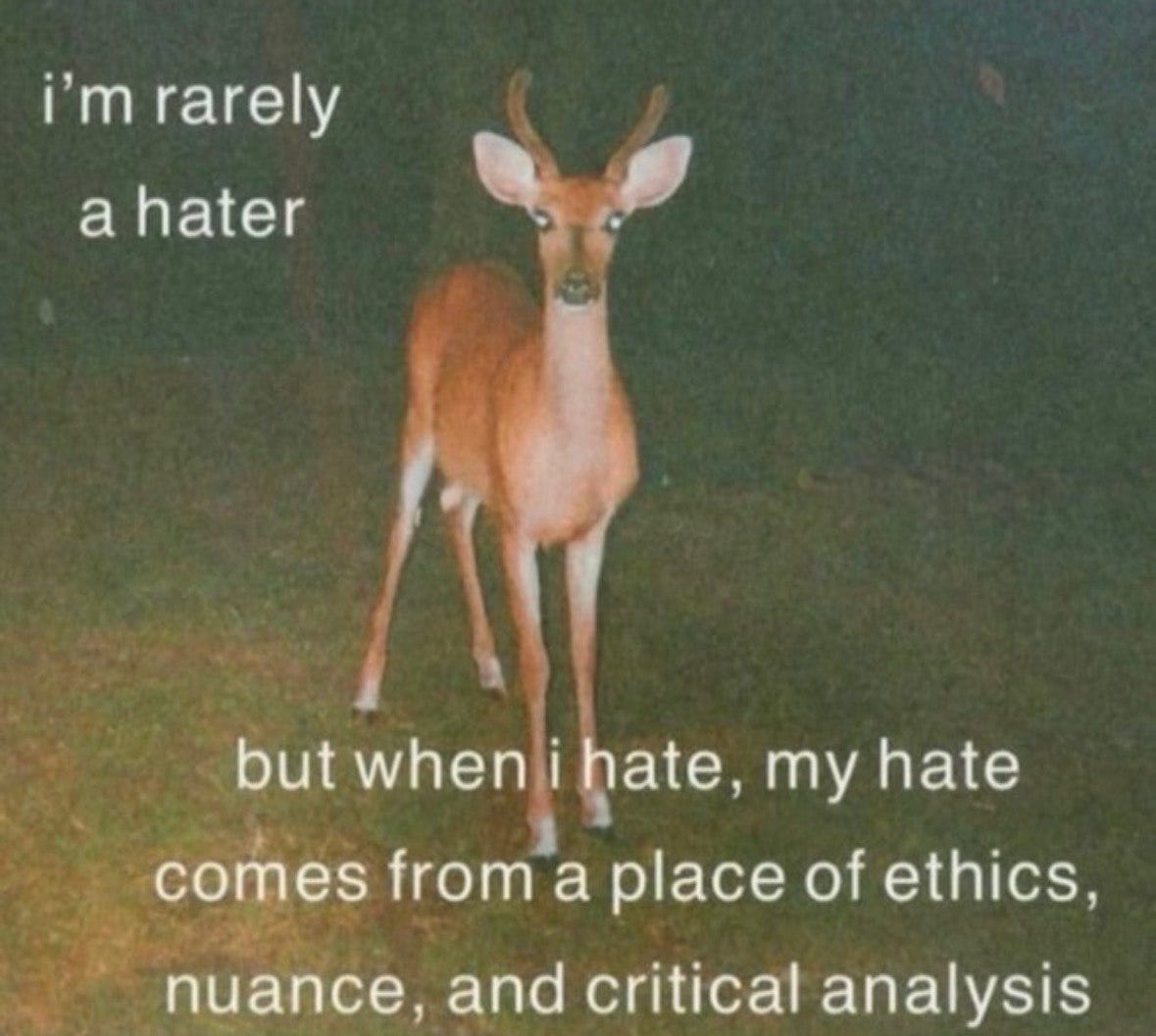
Sooner or later, you just run out of culture war grist. There are essentially no metrics in which the Burger Reich could be considered a success, and even in the areas where it’s doing reasonably well—virtually all of which involve generating needless human suffering—its predations and brutality have fallen short of the depraved fantasies of the fascist cosplayers who conceive and oversee them. With gnarled cable news pundits and defective podcasters sitting atop vital agencies and groyper weirdos and chittering adult libertarians filling out the ranks below, the metaphors collapse instantly into slapstick. MAGA has gotten the society that they insisted upon us, and it’s empirically and observably awful, so all that’s left is to toss culture war bile into the trough. As a movement and an impulse, Trumpism deals in ornate fantasies of resentment and retribution. As a political formation squatting hideously over our national life, it’s about generating spasmodic bursts of state violence and histrionic televised umbrage—all made into sludge-grade content for Trump’s amusement. If the manufactroversy over the Cracker Barrel logo redesign or a college student’s smoothbrain gender essay felt shabby and checked-out, if the TPUSA Super Bowl halftime show felt like the whimpering apotheosis of a claustrophobic monoculture—then the panolopy of chuds fuming about Christopher Nolan’s Odyssey is the soy right’s full-circle metamorphosis into SJWs.
For months leading up to the film’s release, the atavistic idiocy of Matt Walsh-types was a staggering reflection of the grim vacuity and annihilating constriction of Trumpist politics, a soul-deep dedication to terraforming reality so that it more closely resembles its own incoherent grievances. In this instance, it’s a blowsy, stilted derangement over a Black woman cast as the Helen of Troy and a trans actor playing the Greek soldier Sinon—that these characters aren’t “historically accurate” for a film adapted from a mythology that features sirens and a giant cyclops. If this wearying selective outrage feels eerily familiar, well, it’s a degraded and glowering rehash of their arguments over the scientific realism of a Black Little Mermaid in a film that features a talking Rastafarian crab.
All of this is terminally online nerd shit, of course, and perhaps the latest distraction from all the ways that MAGA is bedazzling and disfiguring the global economy. As someone who is ambivalent towards Christopher Nolan, the Odyssey is certainly not above criticism, but the debate around it—whether from the self-stylized gourmet anti-blockbuster cinephiles or the rage-bait culture warriors—feigned little genuine interest in engaging with the film on its merits. Treating art as a cultural signifier reflects a palette that’s based entirely on the demands of personal brand curation. It stems from the idea that movies are weapons in the culture war arsenal, and they should exist primarily to “spread a message”—instead of a profound message or multiple interpretations incidentally arising from compelling storytelling—which is why modern Hollywood is full of turgid, didactic dreck. Online politics has raised a generation of midwits crying about how ambiguity, mystery, or humanity interferes with their propaganda consumption.
Both sides of the culture war are animated by a desire to dominate pop culture and for it to affirm the picture-book binaries that define and proscribe their diminutive understanding of the world. This insatiable demand creates this paranoia that anything that isn’t propagandizing to them is inherently propagandizing against them. Their love or hatred for art is not based on its merits or even a developed personal taste, but whether it reinforces their proclivities or affectations. Art is an invaluable medium for expressing human conflict, but it cannot resolve it. These people cannot appreciate art, or offer any insightful analysis or commentary on it, because they operate on this Hays Code premise that the portrayal of something is definitionally a value judgement for/against that subject. This infects a lot of pop culture and cultural commentary, with prestige TV being the biggest casualty, and degrades art and entertainment into pandering fan service.
Whenever a film or a novel touches on a topic that triggers their personal neuroses, they can’t help but frame these through their off-the-rack ideologies. This hyperpartisan lens creates this toddler-ish blind spot that culture warriors project onto comedians, journalism, movies, shows, music, and novels to co-opt them for their own stunted political ends. I have plenty of dorky cultural interests that I care about to an absurd degree—or at least strains rationality or my other otherwise developed critical faculties—but what makes a lot of cultural discourse beyond stupid and somewhat offensive is the need to shoehorn real-world problems like poverty or grief or trauma into these middling, self-flattering entertainment properties. Libs are also guilty of their own perpetually reinforcing faux-progressive Moral Majority mentality. They’ll use this mawkish, scoldy, hyper-punitive type of language to justify whitewashing “problematic” novels like Huckleberry Finn, or insist the lady Ghostbusters or Wanda Vision or Handsmaid’s Tale are profound #resistance statements, or whip up a moral panic over the Joker movie inspiring incels to do mass shootings, or justify why they’ve put more effort into cancelling Dave Chappelle for his transphobic jokes instead of protesting transphobic legislation.
Much of the culture war is fought by one-dimensional humans who can only operate on the axis of who they despise and what they oppose. They wield culture as a cudgel, but their understanding of it is rote and forced, so all they have is a sad simulacrum of it. When it comes to art that aligns with their values, it’s been drilled into them that they’re “good” and “important,” but they have no actual grasp of the values or valiance attached to them. They’re wedded to a demented partisan pop culture because everything they like has to be in relationship to their “opposition.” They can’t operate in a quietest mode of enjoying culture for its own sake, as it can only be a weapon to attack what they despise. When I see these people rip on broadly or critically acclaimed books/albums/films, there should be social pressure to force them to go on record and list what they consider to be great art.
When I wrote about what constitutes “good taste,” I defined it as a matter of perspective. As the antithesis, what I consider to be “bad taste” doesn’t concern itself with liking the “right” or “wrong” art—or even with “media literacy,” since that has come to mean that a film or book needs to be interpreted the Correct Way, which is subjectively decided by the consensus of whatever community is saying that you need to develop media literacy.
In a similar vein to how I would evaluate intelligence based on how someone thinks rather than what they think, a person with “bad taste” has more to do with the ways they engage with art. Someone has “bad taste” if they…
Judge movies/shows/music/books on whether they espouse political or philosophical views they agree or disagree with.
Judge movies/shows/music/books on whether the protagonist is likeable or relatable, or whether they make choices that they would do.
Judge the merit of movies/shows/music/books strictly off of popularity or cultural relevance.
Assume that the depiction of something is inherently a validation of that thing.
Engage with art on the premise of “What Liking [X] Says About You.”
Like or dislike movies/shows/music/books based on how its fans conduct themselves.
Treat criticism of the movies/shows/music/books they like as an attack on their identity.
Refuse to expand their taste, then dismiss movies/shows/music/books they are ill-equipped to substantively engage with (which is likely a byproduct of them not developing the context or knowledge necessary to understand art that’s more challenging or demanding).
Allow other people’s opinions to significantly influence their enjoyment of movies/shows/music/books.
Say “let people enjoy things” to automatically deflect legitimate criticism.
Fail to put a modicum of effort into proactively seeking out different movies/shows/music/books outside of what the algorithm feeds them or whatever is trendy or mainstream.
When OpenAI president Greg Brokman tweeted “taste is a new core skill,” it confirmed that tech companies view curation and human judgment not as a subjective experience that enriches our lives, but as a required competency to succeed in the contemporary job market. The New Yorker reported on this tech bro tastewashing, citing Anthropic’s NYC pop-up, Zuck’s front row appearance at a Prada show, and OpenAI’s Super Bowl use of handheld cinematography as all part of multi-million-dollar campaigns to make these founders and their companies look cool. In his viral essay, Will Manidis argues that taste becoming a “new core skill” relegates us to a more sophisticated form of consumerism in the face of mass-generated algorithmic slop. “The taste thesis,” he writes, “places man at the end of the chain of creation, evaluating what has already been generated, rather than at the beginning, participating in the generation itself.”
On one level, the concept of trying to quantify taste in a spreadsheet is a prime example of engineer’s disease mixed with VC sociopathy, but it’s also a fundamental misunderstanding of culture. Taste is intrinsically ephemeral and elusive. If you’re wearing clothes that someone else told you were cool, if you listen to the “right” music or watch the “right” films for perceived cultural cache, it won’t matter if you fit into the broad consensus of “good taste,” because it will be obvious that these pursuits aren’t emanating from your relationship to them. Taste is developed through perspective, context, participating in the creative act, and developing relationships with different pieces of art. The type of “new core skill” that tech reptiles like Brockman are emphasizing is the discernment to evaluate what is relatable to others in service of frictionless transactions and online engagement, not to understand what strengthens your relationship to yourself and the world around you.
I’ve seen headlines like “The Feed is Fake” and “The Fanfare Around the Band Geese Actually Was a Psyop” about the sleazy online marketing gimmicks used to promote Justin Bieber and Geese—but it’s important to situate them in context. The entertainment industry has long been fake: There was the payola scandal in the ‘50s where radio station DJs were paid by record labels to play certain artists, and many artists have been accused of being “industry plants.” The difference now is that big media players no longer own the cultural throughlanes of distribution, and they can no longer run massive PR campaigns through a few legacy media gatekeepers. The mass market can only be reached through millions of niches, which means companies need to activate thousands of decentralized voices to tell their story. These are bottom-up campaigns of manufactured discourse, and they’re done like Sabrina Carpenter posing in provocative images to instigate heated debates around her upcoming album as it pertains to feminism, or American Eagle/Pepsi/Gillette weaponizing the shrill and shrieking nature of culture war to associate their products with social justice or anti-woke.
The algorithms of Spotify and Netflix are essentially an intensified payola, so the assumption that art is worse now is a form of recency bias since time has yet to filter out contemporary masterpieces from trend-hopping, derivative garbage. There’s plenty of quality art being made, but it’s also never been easier to consume low-effort dogshit. Since streaming has made music and movies more readily available, the barrier to accessing them is no longer cost and travel—it’s just time and attention. That dynamic, combined with the prevailing poptimist Let people enjoy things ethos, has devalued the role of critics and has developed a reflexive antipathy for snobs. In many aspects, the tastemakers of old have functioned as insufferably behind-the-curve professional idiots, but the social media democratization of culture has overcorrected by replacing them with influencers who are just as beholden to sensationalism and attention-seeking, but lack the technical understanding to add depth or context to their commentary. Likes and comment sections are biased toward the same agreeable consensus picks of best movies or albums. Any rando can be a foodie by obsessing over ring lights or faddy restaurants or sponsored content instead of cultivating deep institutional knowledge. Snobs and critics are the natural predators of our cultural ecosystem. When we killed them off, deer overcrowded the forest, and now we’re dealing with genetic degradation and terrible illnesses.
The goal cannot be to acquire “good taste,” because such a concept is arbitrary and hopelessly subjective, and it is an inherently swagless pursuit. Developing taste is like finding a state of happiness; it’s not something you strive for, it’s something you find yourself in as you pursue the things you care about. In the context of media saturation and PR hijinks, it’s critical to listen to and engage with people who are knowledgeable and passionate about art, and to interact with content by paying as much attention to what you’re not engaging with in relation to what you already like, as both require an exploration of our values.

This piece reminds me of an awesome scene from Tar . She confronts Max who proclaims he doesn’t like Bach because he can’t separate the art from the artist Lydia attacks Max ( and cancel culture ) by proclaiming
“ Don’t be so eager to be offended. The narcissim of small differences leads to the most boring conformity “
Max believes because Bach fathered 20 children he was a misogynist therefore that is a moral disqualification for taking his music seriously.
By that yardstick no one that lives or ever lived on the planet can be taken seriously
Enjoyed this take, Sam. It all seems to boil back down to like what you like and invest your energy into what you want to invest in be curious and pursue art both as a creator and a viewer because who actually decides what is "good" and "bad" taste? It's on each of us to find out what we love from a place of curiosity and honesty (on the outskirts of the deluge of outside voices).
It also reminds me of my favorite quote from Workaholics, "If you don't want to date me, that's fine. I get that. But you're wrong, and I hate you."