
What do we really own?
PART 5: Or reclaim your time from our corporate overlords with extended bathroom breaks.

We’ve all been there. I was enjoying a beer at the local bar when I received an email notification that Apple is billing me $9.99 this month for storage, and has been doing so for the last 18 months. I don’t know if I need it or what it’s for, and I definitely don’t remember signing up for it. It could be related to “the cloud” but I also don’t understand what that means. What would happen if I stopped paying for this? I guess I’d lose some photos of my Euro trip from a few years ago. But this isn’t the only place where things that might feel transcendent, or useful, are caught in some boss’s long shadow, and stunted by some executive cynicism or cornball vanity. Spotify is witnessing the initial stage of an exodus of artists leaving their platform, as many are citing CEO Daniel Ek’s recent investments in military AI technology instead of using those profits to pay the artists that have made him wealthy; but even before that, there must have been some addled tinkering and grim managerial cynicism at play because it showed up downstream in a user interface that feels calculated into entropy. Renting music and its consequences…
For all this grandiose pablum about The Light Of Consciousness and The Future Of Humanity that has come out of Silicon Valley during its ascent, these reptiles have a signature combination of depravity and incompetence, a strange self-conception of progress, and a very huffy view of how they are improving our lives. What has come out has been spectacularly lifeless and anti-human, and if every cultural product on the market increasingly reflects the fundamental and brazen lazy defectiveness in the structural forces that produce it, then it is doubly true that all this technological progress is turning our economy into a glorified rentier albatross. This is most pronounced in how overused and abused the subscription model has become, and it’s deluding the quality of the business and the consumer. The implementation of these glib impulses to squeeze every nickel out of the customer feels like a clammy gag on the ongoing process of enshittification. It also hints at a deeper incoherence and untenability, a sense that something is off when there are businesses whose entire value proposition is to help people cancel their subscriptions. I used to be able to buy Adobe Creative Suite for $300 flat; now I get to pay $300 a year for the rest of my life. I’m not paying rent anymore, I’m paying a housing subscription. Streaming used to be a deal, and now it’s just a more expensive version of cable.
I own nothing, and I’m still unhappy.
One of the most devastating critiques of capitalism I’ve ever encountered was in a Simpsons bit where the guards from Wizard of Oz are protecting Mr. Burns’s compound, except their “Oh wee oh, wee oh” chant was changed to “All we own, we owe.” It is not just a feeling but a fact that this moment is increasingly governed by the fatuity of the richest and most powerful people in the culture, and it has warped everywhere to reflect and serve their idle sadism and zealously anhedonic overall mentality. As I grew up in the aftermath of the Soviet collapse, I was told that socialism failed because the government controls everything and people weren’t allowed to own property, although those arguments never made the distinction between personal and private property. After surviving a few once-in-a-generation economic crises, it seems like mega-corporations and billionaires have leveraged these economic downturns to snatch up more of the economy, and now they own the most valuable lands, most stocks, and most of the wealth. Each successive generation holds fewer assets, is functionally locked out of the housing market, and is downwardly mobile. There is also the effort to create an ideological framework that explains why this is not only just, but vital to human progress. There’s been plenty of rebrands for this kind of parlous economy that is breaking under the pressure of steepening wealth inequality: The sharing economy, the gig economy, whatever.
These powerful people are boring and smug and greedy, but also uninterested in anything but their faddish self-flattering worldview that they mostly tend to reproduce all that. Because these people have bought so much, not just like “political parties” and “the news media,” but things that people actually need and use all the time, the consequences of that small-mindedness rush downhill quickly. Companies like BlackRock are buying up all the most important real estate, and according to a Redfin report, investors bought 26% of affordable homes in the U.S. during the last part of 2023. Institutional investors may control 40% of U.S. single-family rental homes by 2030, according to MetLife Investment Management. This makes it harder for regular buyers, who are already struggling with low availability, rising prices, and high interest rates, to achieve homeownership. But it also begs the question of whether housing policy is meant to be primarily a vector of profit or to shelter people, and what kind of ways increasing corporate ownership of housing supply will shape our communities and living arrangements.
Whether you think billionaires should exist or not depends on whether you also think monarchies or aristocracies are bad. It would be a different equation if we lived in a world where everyone’s needs were met, but the fact that 2% of Elon Musk’s wealth could end world hunger doesn’t scan as much of a coincidence as much as a product of his astronomical fortune has been made possible by this level of disparity. According to Thomas Piketty’s estimations in Capital in the Twenty-First Century, the richest 1% of Americans own 35% of the wealth, and the richest 10% own over 70%. The top three richest men in America own more than the bottom 50% of the country. The Rand Corporation did a study in 2020 and concluded that from 1975 to 2018, nearly $50 trillion in income had been sucked from the middle class to the top 1%; or, if all this money had not been shifted away from the middle class, the median individual income in 2018 would’ve been not the $36,000 it was, but about $57,000. The wealthiest Americans have never owned so much of the stock market, with the top 10% now holding a record 93% of US equities, according to Federal Reserve data. This includes most of the traded corporate stock and assets that represent some of the largest companies that dominate our lives, like Wall Street and Silicon Valley. BlackRock, State Street, and Vanguard are the largest shareholders in 88% of S&P 500 firms and 40% of all U.S. companies, and they dominate the passive investing market and are de facto permanent governing boards for almost half of all listed U.S. corporations. And a Wall Street Journal headline in February confirmed that the U.S. economy is propped up by the top 10% of income earners who “now account for 49.7% of all spending, a record in data going back to 1989, according to an analysis by Moody’s Analytics. Three decades ago, they accounted for about 36%.” Since our economy is oriented around catering to the spending habits of high-income earners, this has ballooned the cost of everything—dining out, renting, going to concerts, groceries, car payments—and prices out most people from an economy they work to keep functioning.
This horrifying power asymmetry has stripped away any kind of bargaining leverage—wages have stagnated not because CEOs have gotten better and workers have gotten worse, but because of a series of policies that have stripped labor of its negotiating power. Most of the working population is still forced by what Karl Marx has called the “dull compulsion” of economic necessity to spend half their waking hours, most days of the week, following orders from unelected bosses. In an economy that presents the options of work or suffer, garbage managerial practices and burnout and degrading work conditions are disguised by the legal form of voluntary employment between “equal” parties. There’s a portion of the day in which we labor to produce products and services that are equivalent to what is paid out to us in wages or salary—but most of us have no equity in the company, don’t receive an equal share of the company’s profits, or have any ownership of the corporate governance that shapes our day-to-day workplace environment. We don’t even really own most of our waking hours. Sure, we can work for another company, but the basic shape of the arrangement will be the same: If we want a job and stay out of poverty, then we have to sublimate our personalities and desires and conform to whatever is best for the company.
As wealth and power and property increasingly concentrate in fewer hands, it has swapped out actually ennobling liberty or more fundamental freedom for choice. But since most of these are not really choices in any meaningful way, it might be more accurate to say that contemporary American life offers selections. Who we rent from, which banking or telecomm oligopoly we want to overcharge us, which concerts from Ticketmaster are we fine with charging us service fees—it’s all in service of making us feel ownership over our decisions, even if they are influenced by whims of economic forces beyond our comprehension. The choice between paying for health insurance and running up six figures of debt because you got sick, for example, is less of a choice than a hostage situation. But because the second outcome is still very possible even if you choose to pay for health insurance, it’s more correct to say that the choice has already been made for you, and that decision is more about choosing from a variety of variously insufficient and predatory options with different names and price points. Sometimes there isn’t even that, and the choice is a binary one between something and nothing. None of that is what any rational or sane person would choose, but these grotesque individuated choices are what we get.


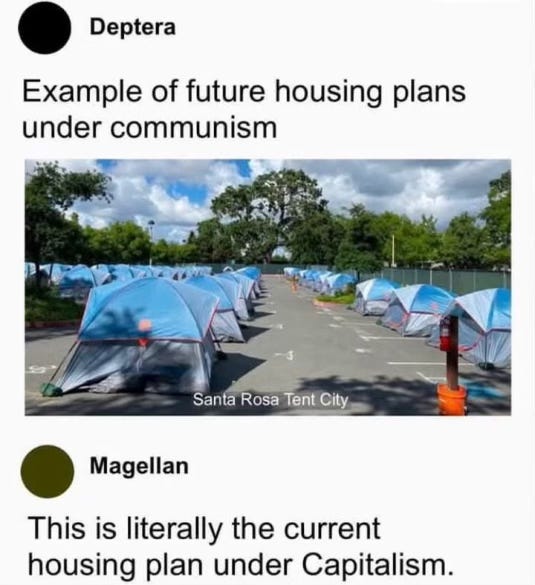
Sidenote: The photo of Santa Rosa (CA) tent city is the result of Newsome's failed policy on homelessness. He can't even account for the $28 billion (and growing) that he has authorized to 30 programs via 9 state agencies since 2019. Now add our state's failed policies on letting addicts shoot up on the street and a lack of residential treatment and mental health facilities despite additional millions spent. I'd like to know where that money goes because it is clearly not reaching the people who need help.
So food for thought, here.
2% of Elon's net worth is just under $10 billion dollars (currently a cool $480 billion).
By contrast, the United States government spent about $142 billion dollars on the Supplemental Assistance and Nutrition Program (SNAP) for Americans alone in 2024, down slightly from the "max out my credit card" years of pandemic level spending. That does not include other funded federal, state and local initiatives aimed at relieving hunger which, in the US alone, gets that number much closer to Elon's complete net worth, if not higher.
Going to go out on a limb and suggest that the elimination of world hunger isn't due to a lack of "resources" or the greed of the individual so much as it is the fact that problems can't, don't, and won't go away by throwing money at them.