

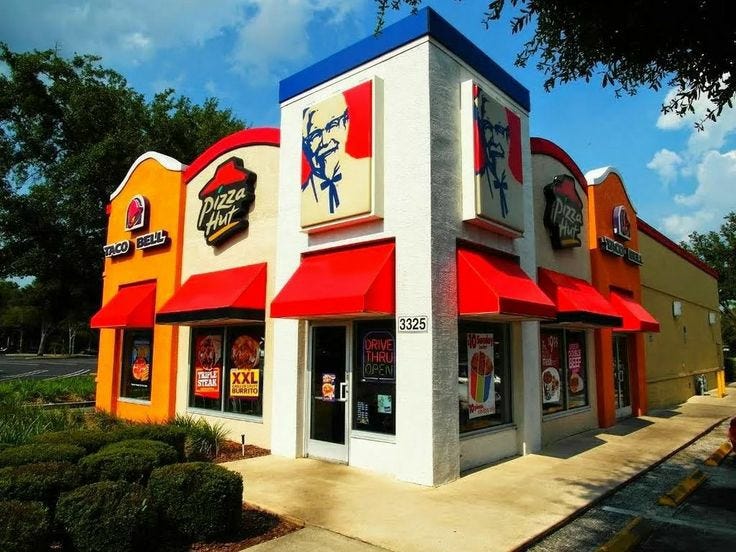
In the 1970s, the question Is Pepsi okay? was ubiquitous in restaurants when the preferred choice, Coca-Cola, was unavailable. It was patently obvious that Pepsi was an undesirable alternative and at least subconsciously evident that it tasted like batteries, so restaurants would repeatedly turn it down and the second-rate soda company came to terms with its inability to compete in the free market. As is the biological imperative of Big Business, they deployed a team of thoroughbred quants to deftly work some angles and analyze some data, and they realized it would be cheaper to buy three fast food chains than it would be to go to brand war with Coke. So Pepsi acquired Pizza Hut, Taco Bell, and KFC, and then merged them and ran this deep-fried troika as a subdivision. This elegant finessing maneuver carried out the remorselessly brutal work of monopolization that bears a real human cost, and eventually, this division was spun off as its own company, called Yum! Brands because this was a market-savvy mechanism to encapsulate a market while slashing costs and trimming overhead. Since neoliberalism conditions management on arbitrage-obsessed quarterly growth, these savings were leveraged to lobby federal and state governments to halt any potential minimum wage increase, so all that money that would otherwise go to helping a cashier buy groceries can keep flowing up to shareholders.
(Fun fact: They also stage coups in Latin American countries.)
It is striking, but not really surprising, that all this cooly sensible branding and machine-tooled efficiency tends to deliver the same solution, which amounts to more for execs and less for everyone else. There doesn’t seem to be any reckoning coming, but there is something perversely numbing and darkly apropos about seeing where all this restructuring and game theorizing would end up. All those merciless cullings and endless organizational refinements, all resolving to me sitting on a curb in a parking lot holding a Crunch Wrap Supreme since the goddamn Taco Bell lobby was closed, likely because the understaffed and underpaid kitchen was buzzing around, busy as hell, and there’s no one available to maintain the lobby. The whole experience is surreal and disorienting, as if I’m living in that Das Racist song.
It’s already degrading to find myself in a situation where I am resigned to eat at Taco Bell, but since I’m in this position anyway, it would be preferable to eat at a table in case any of this gets on my shirt—and it inevitably did because Crunch Wrap Supremes are messy and I’m hopelessly incompetent. I just wanted to eat some inhuman Mexican-esque slop without carrying the evidentiary shame around for the rest of the day, but apparently, a billion-dollar oligopoly doesn’t have the capabilities to maintain a fully functional restaurant. This is a problem that could be solved with comparatively small expenditures—or by simply eliminating a whole lot of jobs. Which would you expect to be a corporation’s preferred solution? We’re doing the Fourth Reich in the name of treats, and now what was once an evil but cozy enterprise has morphed into a drive-thru with a secondary inside experience, and now I’ve become an All-American hog by complaining about this. I also needed to access the bathrooms, and now I have bits of Crunch Wrap supreme all over my shirt, and I smell like spicy dog food. Fuck Pepsi. This is neoliberal hell.
As governments are run more like businesses and businesses are run more like vampires, it is strange to see one particular fear of socialism persist: That small, unelected groups of bureaucrats will decide what to make and sell. In an economy dominated by oligarchs, shareholders, and holding companies, this is already the logical progression of neoliberal policies that concentrate wealth upward. In his book Capitalism vs. Freedom, economist Rob Larson writes, “Rather than the ‘planned economy’ of socialism that haunts Hayek’s dreams, it is corporate monopoly and oligopoly, and their industrial organizations, that are the main source of today’s central planning.” As industries consolidate, monopolies achieve greater control over our lives.
It’s easy to see how neoliberalism, and the larger worldview informing it, appeals to well-heeled establishment types of every political stripe. Capitalism presents itself as a luxurious and state-of-the-art solution to resource allocation and wealth generation, and it just so happens that all of that decision-making goes to a select few unaccountable individuals. The Gilded Age is remembered as a time of pure laissez-faire capitalism, but it wasn’t an era flourishing with enduring competition: It was defined by classic free-market monopolies like Standard Oil, American Tobacco, and U.S. Steel. Monopoly and oligopoly are everywhere now. Walmart has amassed a “trading monopoly,” and they brandish their power by dictating terms to wholesalers through rendering regional competition unviable. Amazon’s infamous “Gazelle Project” squeezes small book publishers as much as possible, and one senior Amazon executive “took an almost sadistic delight in pressuring book publishers to give Amazon more favorable financial terms.” Barry Lynn writes about concentrating “market structures,” often obscured by maintaining independent brand names even after giant holding companies subsume them. Nine of the 10 bestselling brands of bottled water are sold by Pepsi, Coke, and Nestlé. Molson Coors and AB InBev control 90% of America’s domestic beer production. Five banks manage half of the financial industry’s assets. Four airlines fly 80% of American passengers. GE, News Corp., Disney, Viacom, Time Warner, and CBS broadcast 90% of American media.
Large corporations essentially function as private governments. The howlingly malign ways that Big Tech has made our society dumber and crueler are innumerable, but their market domination has given their decision-making outsize control over people’s speech. The more these social media and search-engine giants can dominate a market and consolidate control over our information, the more their company policies can penetrate our everyday lives. Zuck, Apple, Google searches, and race-baiting YouTube algorithms can actively subvert the First Amendment if they delete your account, shadowban you, or even destroy your livelihood if you’re a small business that’s dependent on their platforms. These tech CEOs don’t have to run for reelection, and there is no disclosure or accountability for how our data is handled or how these algorithms work. I wasn’t sad to see Alex Jones booted from YouTube, but it is concerning to see a domain operating without any established principles of law. If the government attempts to suppress our freedom of speech, it’s at least held in check by the First Amendment, a massive body of case law, and a Supreme Court that decides whether a particular restriction falls into an accepted category of rights that can be prohibited. This does not happen with corporate censorship: You’re informed of the decision and given no reasons behind it beyond Violating the Terms of Service—which can change on a whim—and there is no appeal process, and they owe you no explanation.
Friedrich von Hayek, one of the foremost intellectual defenders of capitalism, wrote that “so long as property is divided among many owners, none of them acting independently has exclusive power to determine the income position of particular people.” When property is not divided among many owners, the free market just becomes the whims and preferences of a small cohort of executives. What is the job market other than these people dictating to you what your labor is worth? As Jefferson Cowie documented In Capital Moves, Jefferson Cowie describes how RCA reacted when its workers threatened to gain the upper hand:
“Each of RCA’s plant relocations represents the corporation’s response to workers’ increasing sense of entitlement and control over investment in their community. Capital flight was a means of countering that control as the company sought out new reservoirs of controllable labor.”
The idea of freedom tends to be an informal synonym for capitalism, which obscures all the ways that the two are in conflict, if not antagonistic, with one another. When companies aren’t held accountable for the negative externalities they produce, this outcome is rarely framed as a threat to our freedom. If we’re interpreting capitalism through the lens of freedom, then we should consider the consequences of industrial capitalism for the lives of the billions of people who have yet to be born. Assuming carbon emissions hold at their current rate, future generations will not be free to enjoy the same richly diverse living planet we have, nor will not be free from the catastrophic consequences that come from a boiling and lifeless biosphere. The right criticizes the Green New Deal because there is something socialistic and “anti-liberty” about using taxation to fund projects that would try to get our economy closer to zero emissions. But climate change is the greatest threat to people’s freedom. Rising temperatures and sea levels are expected to create hundreds of millions of climate refugees, people who have to flee their homes because of the consequences of climate change and circumstances that are out of their control.
And “political freedom” and “economic freedom” cannot easily be separated. Many libertarians will justify economic inequality, so long as people are “equal under the law.” But because money is always going to be power, economic inequality will always translate into differences in political influence. Rupert Murdoch has a far greater capacity to set the political agenda than we do. Mick Mulvaney, the interim White House chief of staff, brazenly admitted that money determined who he listened to while serving as a congressman: “If you were a lobbyist who never gave us money, I didn’t talk to you. If you were a lobbyist who gave us money, I might talk to you.” That’s not just because American capitalism is a uniquely corrupt form of cronyism. It’s also because money influences voters, and elected officials are dependent on votes. There’s also the famous Princeton study that analyzed 1,779 policy outcomes from 1981 to 2002, finding that “economic elites and organized groups representing business interests have substantial independent impacts on US government policy,” while average citizens “have little or no independent influence.” As the economist Robin Hahnel says, in the marketplace, “it is not one person one vote, but one dollar one vote,” and “people have vastly different numbers of dollar ballots to cast in market elections.”
Power is more than just the government putting people in jail. Power relations are everywhere, and our choices are structured by our circumstances, and our circumstances are structured by the political and economic systems we live in, and those systems are structured by decisions that are made by people with power—whether they are on Capitol Hill or a corporate boardroom. This is why it’s important to distinguish between negative liberty and positive liberty, the freedom from and the freedom to. It’s not enough to be free from interference; you actually need to have the capacity to act. The goal, then, is for people to be free of all of this. And you can make people freer in lots of different ways. If you have strong laws protecting political speech, then while an employer is less free to discipline people for what they do outside of work, the employees are freer to speak their minds. If you are free to easily unionize, then workers have the power to collectively withhold their labor if there are managers who abuse their power. If being a single mother wasn’t such a financially terrifying prospect, because we had a more generous welfare state that made it easy to raise children, the idea of leaving a bad marriage or relationship wouldn’t be quite as difficult to contemplate. If healthcare is provided free at the point of service and funded through progressive taxation, then people are freer to go about their lives without having to worry about whether they can afford to get sick.
It’s important to talk about democracy and freedom together, and one definition of freedom that has been proposed is that “freedom is participation in power,” that is, that freedom and democracy should be considered either the same thing or closely tied. Economic inequality and the concentration of wealth and political power in the hands of the few weaken democracy and limit freedom. If inequality remains unchecked, if we don’t build a robust middle class, if we can’t deliver the kind of social safety net that’s on offer in every other developed nation, if we can’t properly tax wealth, if we can’t convince businesses that their long-term interests are better served by a healthy and well-educated society, then the impacts on democracy will be severe, and our society will eventually fail. “Freedom” is not freedom if you work full-time and live in poverty, or if a single medical crisis can drive you into bankruptcy, or if childcare is too expensive for you to hold a job, or if you’re born in the wrong zip code and underfunded schools and overpriced colleged and usurious student loans block you from reaching your fullest potential. Looked at another way, an expanded social safety net gives people the freedom to change jobs without worrying about their health coverage, to go to college without falling into crippling debt, to stay in their hometown because a certain level of public investment has made opportunities available there. Or, at the very least, this kind of freedom would give Taco Bell workers the dignity of fair wages, amenable workplace conditions, and the authority to maintain a lobby so I have the freedom to clean the Grade-D meat slop off my shirt and go about my day in peace.


Well said. I think associating freedom with capitalism is a funny thing because in that sense, you're only "free" as the purveyors of whatever goods and services you're patronizing want you to be. You can only download whatever apps onto your iPhone Apple says you can, eat what Taco Bell decides to put on their menu, or vote for whatever candidates the DNC or GOP decide to run.
Great article. As it stands now, the money for social saftey nets comes out of the ever shrinking pockets of overworked working people, which then aren't allocated to the programs we should be funding. We could fund all of these programs and more with the spare change that falls out of the pockets of our corporate and institutional millionaires. I just read Harvard's endowment is $56.9 billion. Also, many businesses are disguised as charities and foundations that could use an audit.