
What am I jamming to?
April 2026: We're talking Drake, Geese, Kanye, and our first discography tier.


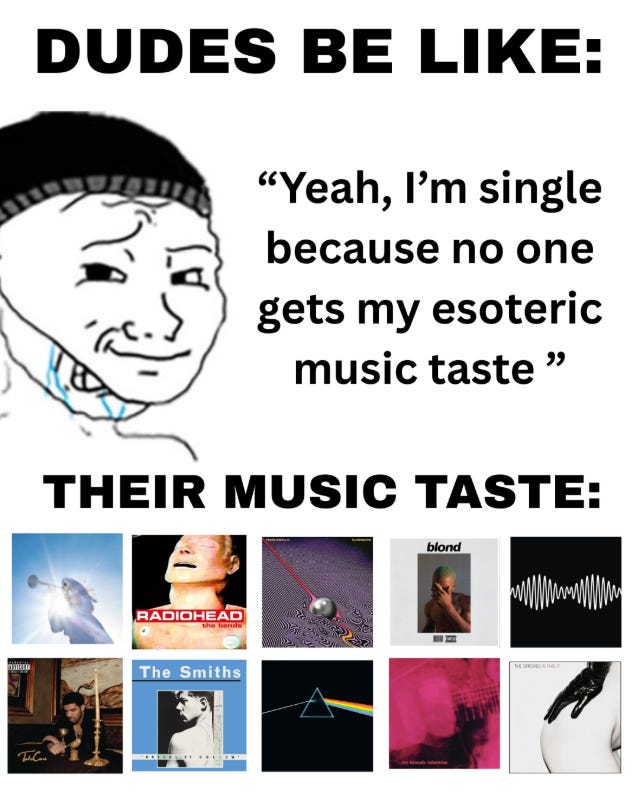
Drake is to summer as Mariah Carey is to Christmas. Outside of Nothing was the Same, I’m not particularly a big fan of his music, but I must begrudgingly concede that Drake owns the months of May to September. It took one Iceman sculpture in downtown Toronto to make everyone forget their former allegiances from two summers ago, when we were all chanting “A Minor.” Now every Arab and Indian fuckboy within the GTA is going into credit card debt to snag two hoodies, one that says “Drizzy says he misses me” and the other says “Property of the 6ix.” These days, the vibes within the broader culture have been horrendously borked, and Drake knows what we need when the weather gets warm. “One Dance” carried a whole decade. He knows the ladies need a lyric that says “no man can hold me down” to add to their Instagram story of their flight to Cancun. He knows the dudes need a song to add to their story featuring a video from the backseat of an Uber at 2 AM as it passes by the CN Tower—except even the 0.5 zoom can only capture the bottom third of it, so no one outside of Toronto knows what this is—as you write about how it was never a doubt that you run this city. We were calling him a certified pedophile, and now that the Epstein Files have revealed endless troves of emails from actual pedophiles, we’re back to looking forward to some new bangers called “Island Feelings” or “God’s Plan Part 2.”
Speaking of hype, Geese has come under fire for hiring Chaotic Good to promote their latest album, Getting Killed, through bots and fake fan accounts. I like Geese, so even if this marketing tactic is unambiguously sleazy, they didn’t create the perverse incentives of corporatized social media and the attendant attention economy. While I don’t judge Geese too harshly for this nor do I think they’re egregiously guilty, this is just another deflating confirmation that we’re living in dead internet theory—especially since the indie blog era and early music forums felt like a treasure trove of grassroots music discovery.
But I also despise the notion that people could only like a band because they were manipulated into it, as if defining your taste against hype-cycles isn’t just an ancillary way of succumbing to a marketing campaign. Geese fit into an underserved niche at the right time, and at least some of the over-hate against them seems to stem from this idea that reflexive contrarianism is the ultimate expression of free will. As much as I enjoyed their last two releases, they’re still one or two albums away from being a truly decade-defining indie rock band in the way that the Strokes or Vampire Weekend are. Admittedly, the hype surrounding them is a tad overbearing, since people are desperate for the days of cool, artsy, alternative rock bands, so this gravitas has been projected onto them before they’ve fully earned the acclaim. And anyone acting like Geese came out of nowhere simply doesn’t know ball—3D Country and Cameron Winter’s Heavy Metal have steadily built up their fanbase over the last few years. Their next few projects will reveal how much staying power they actually have, but they have the potential to be that decade-defining band if they continue this momentum.
With all that said, Kevin Alexander and I are pleased to announce our first-ever tiering, where we take the discographies of our favorite artists and assess how all their albums stack up to each other. Between our Top 100 Albums series and this monthly segment, I have subjected poor Kevin to three Radiohead albums and three Smiles side-projects, and I’m afraid he’ll never truly appreciate their greatness because he simply isn’t depressed enough. So I proposed we kick this off with New Order, as this was an opportunity for me to venture beyond their ‘80s catalogue and for Kevin to wax poetic about his favorite band.
Before we dive in, here is our agreed-upon tiering criteria:
S-Tier: No-skip tracklist, either among my personal favorites or in the conversation of best albums of all time. (10/10)
A-Tier: Among the best albums of their genre or decade. (9/10)
B-Tier: Among the best albums of their year. (8/10)
C-Tier: An enjoyable listen, worth checking out if you’re a fan of the band or genre, but not quite classic. (6-7/10)
D-Tier: Either mid or hit-or-miss tracklist. (4-5/10)
E-Tier: Pretty bad but not a total trainwreck. (2-3/10)
F-Tier: There is nothing redeemable about this. (1/10)
This intro has gone on long enough, so let’s get to the goodies.
April’s Topster:
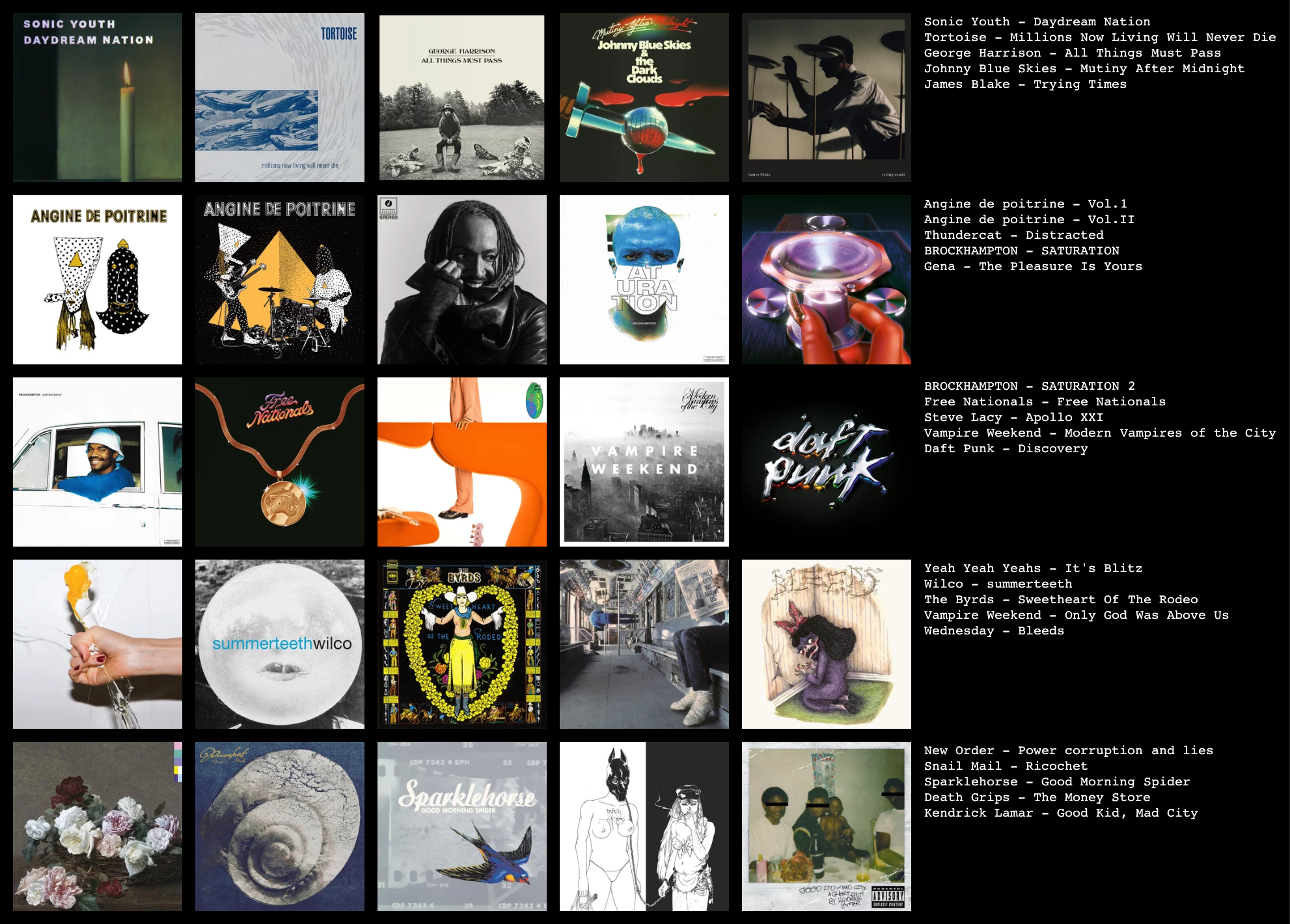
I took on the Pitchfork Best Albums Bracket:
In case you missed it, Pitchfork celebrated its 30th anniversary by doing a March Madness-style bracket of each of its Album of the Year selections. It was a fun excuse to review some albums I like and to see which of their AOTY picks have aged well and which have aged like milk. The brackets generated the most stereotypical Pitchfork result imaginable, but in this trilogy, I learned that I’m still fairly tapped into the culture, or I just have basic hipster taste.


This month’s live performances:
Clipse
Haley Williams, Jeff Tweedy, and Unknown Mortal Orchestra
Thee OSEES
Ty Segall & Freedom Band
My obligatory Kanye take/Bully review.
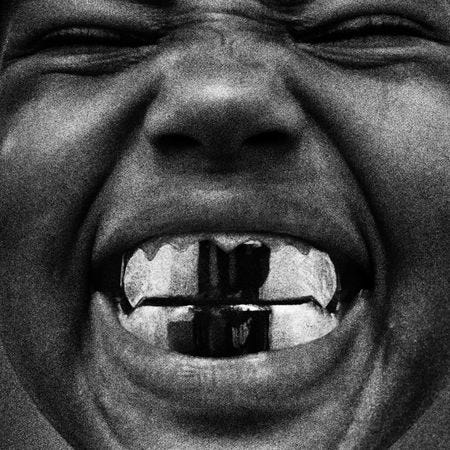
Bully has the same issues as every Kanye release in the 2020s, just without the corny bars that praise Hitler and convicted rapists. Uncharacteristically bland and inoffensive, it’s a cheap nostalgia ploy that begs the listener to forget about his abhorrent behavior and to remember him as the guy who made Graduation. Full of barely two-minute fragments, this is a tracklist full of the potential for what could’ve been good songs rather than actual good songs, a playlist of directionless concepts that would either abruptly end after a verse, repeat the chorus, or stall into a sample loop whenever it seemed to gain momentum.
The most striking aspect is the hollow feeling of loneliness and isolation. The 29-track Donda contained five songs without features, while Bully boasts maybe a half-dozen guest appearances, which likely contributes to its brevity since Kanye doesn’t have the creative discipline at this stage of his career to flesh out these ideas on his own. The bare-bones and undercooked production oddly suits his alienation from the broader culture; it’d be extremely inappropriate if his post-Nazi comeback were as grandiose as My Beautiful Dark Twisted Fantasy or as abrasive as Yeezus. Where past samples animated his songs with chipmunk-soul life, here it’s mellow and cold. I do question whether there was some intentionality in Bully’s undeveloped nature, like Kanye left empty space for us to fill in the blanks. This doesn’t make Bully a satisfying listen, of course, but it’s an exasperated homecoming of sorts, as if Kanye is trying to find himself after making a mess of his life.
Where Kanye’s previous albums contextualized his personal life and media attention, here, the subject matter feels irrelevant. The irony is that Kanye could reconcile with losing everything to his bipolar disorder and narcissistic tendencies, trying to figure out whether he is his worst impulses or if there is a greater, darker force behind his behavior. Instead, we’re left with a ghost. Bully is a posthumous record for a man we’ve simply lost touch with.
There’s the larger question of where he even fits into the culture anymore (assuming he’s off the Nazi shit), given that he has crossed unforgivable lines for many. Expecting a 48-year-old recovering nitrous addict with significant mental health issues to resume his generational run might’ve been misplaced, as he will struggle to reach his former levels of artistic expression. Maybe that doesn’t matter to whoever flocked to his sold-out show in Mexico City or to those catapulting Bully to the top of the Billboards. There are glimmers of his magic, snippets of spectacular and unique soundscapes, but it will be a process before he can turn these ideas into memorable songs consistently. Forget what 2005 Kanye could’ve done with “PREACHER MAN” or how 2015 Kanye could’ve chopped up “I CAN’T WAIT”—even Donda-era Kanye dropped “Life of the Party” and “Believe What I Say,” which only further punctuates this precipitous five-year nosedive. For anyone expecting Kanye to reach the highs of his first seven albums, Bully is the first step towards something that will never happen. But there’s enough here to suggest he may have some more ye- or Kids See Ghosts-tier albums left in him.
SCORE: 4/10
HIGHLIGHTS: KING, ALL THE LOVE, PUNCH DRUNK, I CAN’T WAIT, PREACHER MAN, BEAUTY AND THE BEAST1
And check out “On Repeat Records!”

At last… Onto this month’s tier: New Order
S-Tier:
Power, Corruption & Lies (1983)
Power, Corruption & Lies is not only a definitive album of both new wave and synth pop, but it feels like a proper introduction to Joy Division. This is the first true glimpse into the band’s unparalleled knack for crafting simple melodies that prick at the heart like rose thorns. The themes of loss, sadness, and isolation are exquisitely packaged into a sense of death and renewal. Four tracks in particular are about as perfect an embodiment of New Order’s delicate intelligence and direct rush as you’ll find in their catalogue. The pulsating baseline of “Age of Consent” builds into highly charged power pop, or maybe electro-folk. “The Village,” the album’s one truly joyful track, is some artsy and progressive pop. “Your Silent Face” turned disco into a sublime experience of introverted, understated beauty that was truly art rock for the eighties. “Leave Me Alone” closed the album on an epiphany of pure multi-layered guitar-pop perfection.
Substance (1987)
Honestly, this is where society peaked. Substance isn’t a typical compilation album, as New Order weren’t big on the idea of including singles on standard releases, so this is a double album with 12” versions of the band’s first dozen singles on the first, and their corresponding B-sides on the second. As each tracklist is sequenced in chronological order, we get a compelling insight into how they evolved from the ashes of Joy Division and into crossover pioneers of electronic music. And for a compilation album, it flows pretty cohesively. Each track perfectly blends misery and euphoria. It’s synth-pop that sounds deeply human. The lyrics are simultaneously stupid, endearingly rhythmic, and oddly profound. These melodies will slowly wrap around your soul. And, of course, there’s Peter Hook’s bass playing. Substance gives you 10 New Order essentials: “Blue Monday, “Temptation,” “Everything’s Gone Green,” “Perfect Kiss,” “Ceremony,” “Subculture,” “Bizarre Love Triangle,” “True Faith, “Procession,” and “Thieves Like Us.”
Technique (1989)
“More synths” were the last words of Johann Wolfgang von Goethe, and New Order took it to heart, channeling the breezy interplay of Brotherhood and drenching it in breezy Ibiza vibes. This album perfectly captures the essence of New Order: Danceable, yet rocky, indie, heartfelt, and piss-taking. It’s an enigma in that it is their defining artistic statement without saying anything specific. It’s just fun. Hook’s basslines are as delicious as ever, and some jangle pop moments almost sound like New Order doing the Smiths. The last three songs are absolute perfection, and “Dream Attack” is probably their greatest meshing of heartfelt emotion into concise lyricism.
I remember reading a review that (erroneously) stated that it was hard for the author to imagine Daft Punk being considered cool in 2030, which misses the entire point of this type of dance music: Both Daft Punk and New Order share a love of electronic experimentation. Sure, Technique isn’t a monolithic epic statement like Joy Division’s Closer or The Cure’s Disintegration, but it doesn’t need to be. New Order transcends time with their music because of the emotions it evokes, and it delivers a blast of sonic presence that captures feeling in a way no one has done before or since. When it comes to the sound of a broken psyche, New Order never misses a beat.
A-Tier:
Low-Life (1985)
Low-Life is consistently danceable and has anything you’d want out of a synth-pop album. The melodies are incredibly catchy, the synth tones are both energetic and gloomy, the guitar work is sharp, and the production is flawless. There are countless layers to the instrumentation, sounding like an absolute windstorm of synths. The only minor downside to this record is that the tracklist is so sonically cohesive that at times, the songs blend into one another. Maybe some more variety could’ve made the record more dynamic, but this is still top-tier. This album contains plenty of memorable tunes, like the killer opener “Love Vigilantes,” the iconic OG version of “Perfect Kiss,” the intense “Elegia,” and the gorgeous “Sooner Than You Think.”
B-Tier:
Brotherhood (1986)
This is the Punch-Drunk Love of albums. Brotherhood tends to be overlooked, as it is unfortunately situated between two superior studio projects. But it is a life-affirming album. It’s often misunderstood and overlooked as the weak link in New Order’s remarkable ‘80s run, since it’s not as groundbreaking as Power, Corruption & Lies or Low-Life, but it’s not looking to push boundaries as much as it’s pushing New Order’s established sound to its logical limit. And it led to their most off-the-wall, off-beat, silly, sensational, and euphoric record. The atmospheric grooves here are made with more finesse than any modern computer-rocker. The themes of brotherhood, relationships, and connection are fully realized here, and not a single second of it is wasted.
C-Tier:
Movement (1981)
The spectre of Ian Curtis’s death looms over this record. Back when they were Joy Division, their frontman would listen to their jamming, single out the riffs and melodies that were sharp and well-defined, and the band would follow his instinct as he guided these disparate parts into fully formed songs. Their ability to form sharp post-punk songs was clearly damaged here, as this is a record of a new band struggling to tether songs into a clear direction. So the record feels a bit aimless, vague, unsure of itself. But hearing the band in a less defined form, focused more on mood and instruments, gives this record an eerie Blade Runner feel that’s as entrancing as it is intriguing. If Joy Division is darkness, then New Order is daylight—albeit a cold day—and Movement is exactly what it implies: The early sunrise where the sky is both night but also clearly dawn. A darkness that begins to glow.
Republic (1993)
While New Order’s previous albums sound like the ‘80s, they manage to feel timeless. Republic, on the other hand, is locked to the ‘90s to the point where it sometimes sounds like dated cheese. Another issue is that if it weren’t for Bernard Sumner’s unique voice, this would sound like any other synth-pop band. Despite these criticisms, the tracklist is consistently danceable, even if it lacks that distinctive New Order magic. But the opener, “Regret,” has one of their most memorable choruses and earworm riffs. Other highlights include “World,” “Ruined for a Day,” “Spooky,” “Liar,” “Times Change,” and “Special.”
Get Ready (2001)
The idea of New Order stripping back their definitive synth-pop gloss and returning to their post-punk roots is a genius idea for a comeback album, especially one that arrived during the garage rock/post-punk revival boom. The rougher production is reminiscent of Movement, which feels like a fitting send-off to the band’s original lineup. “Crystal” is another notch in their run of fantastic openers, starting with a synth-heavy introduction before a disgustingly catchy guitar riff kicks in. “Primitive Notion” has that classic-sounding Hook bassline before exploding into a rock anthem. “Vicious Streak” and “Someone Like You” are the most traditionally sounding New Order songs on an album that doesn’t feature a strong synth presence, although they do sound great when they’re used. This is definitely a deep cut New Order album, an interesting time capsule of a specific period in their career.
D-Tier:
Waiting for the Sirens’ Call (2005)
This is New Order at their most polished, but they sound like a commercial legacy act. The first four tracks are pretty solid, but the rest are forgettable. Although the cover art did tell us in big orange letters not to listen to this. About halfway through, “I Told You So” reminds us of our mistake. Then, we realize “Guilt is a Useless Emotion” because we won’t get our time or money back. We were warned.
Music Complete (2015)
New Order goes house. Music Complete opens with a pretty decent three-track run, but it immediately nosedives into one of their goofiest and most annoying tracks, “Tutti Frutti,” and never really fully recovers. There’s the bizarre spoken word nonsense on “Stray Dog,” the lumbering alternative migraine music on “Unlearn This Hatred,” and the supremely irritating synth-pop of “The Game.” Even the highlights are essentially C-Tier New Order tunes. There isn’t much of a reason to listen to this unless you’re a completionist.
E-Tier:
Lost Sirens (2013)
This is just a very inconsequential collection of songs. It’s very clear that Peter Hook’s contributions are sorely missed.
F-Tier:
N/A
KEVIN’S NEW ORDER TIER:
S-Tier: Power, Corruption & Lies / Technique / Substance
A-Tier: Low-Life
B-Tier: Brotherhood / Republic
C-Tier: Get Ready / Movement / Waiting for the Siren’s Call
D-Tier: Lost Sirens / Music Complete
E-Tier: N/A
F-Tier: N/A
My Response:
I’m surprised at how much overlap we have, with Kevin placing Republic, Lost Sirens, and Waiting for the Siren’s Call one tier above me, respectively.
PREVIOUS:

Eric McGoey, since you DM’d me about my Kanye take, as it was a deleted Note, I resurrected it and included it here as part of my experimenting with this new format.
 | A guest post by
|